Wednesday, 8 April 2015

Gaming : Pokémon Red(Fourth Gen)

 Pokémon Red


Box Cover

Game Details :


Developer : Game Freak
Publisher : Nintendo
Artist : Ken Sugimori
Platform : Gameboy


Release date(s) Red
JP February 27, 1996
NA September 28, 1998
AUS October 23, 1998
EU October 5, 1999

Game Information


It was published by Game Freak and initially called Pocket Monsters upon its release in Japan. Pokemon was the first of a series that will pull through the ages leading to TV shows ,merchandise and many reworks of the game itself. It was praised by many critics especially because of its multiplier feature and trading system. Scoring 89% on gamerankings.com and is indefinitely ranked on the top game list and also lasting 4 years on IGN's Top 100 Games of all time. 

The beginning of the game you try to progress to some deep grass but a voice warns you other wise. The voice belongs to a Professor called Oak who is a well known Pokemon researcher. He tells you that it is dangerous to go alone as it could be very dangerous, when he then leads you to his lab. There you meat Oaks grandson who becomes the players arch rival throughout the game. You are then required to select a starting Pokemon which will lead to a battle with your rival.

Plot 


This game takes place in the land of Kanto. It holds different habitats where where the 151 different types of Pokemon can be found. The player must learn special abilities in order to progress to certain areas.


Professor oak Talking to player
The player then must visit cities in this region to look for and defeat the gym leaders. and obtain the gym badges, when collection them all the player is allowed to battle the elite four and the new champion which is the players rival. Another group are team rocket a devious group who want to control Pokemon, the player must foil there planes to protect the Pokemon. Another achievement is to collect every type of Pokemon to fill your Pokedex.

Gameplay


Battle taking place


Wile progressing through the game the player will encounter battles. The screen changes to suit the turn battle system . While in battle the player has 4 options to choose from, either select one of four moves of which to attack with, to use an item equipped to the current Pokemon, To flee the battle and to change the Pokemon which is currently in battle. While in battle the Pokemon have Hp (Hit Points) which upon reaching 0 they faint and the player will have to choose another Pokemon. If none are available the player will lose the battle. When each Pokemon is defeated the Pokemon which had taken part in the battle will gain exp. When each Pokemon has accumulated enough exp the Pokemon will lvl up increasing its base stats. Pokemon may also evolve at certain lvles increasing their base stats and granting incremented stats per level.Whilst lvling up the Pokemon may also learn new moves which he will be able to use in battle,


Catching A Pokemon
The Trainer may also have the option of catching the Pokemon being fought using poke balls which can either be found or bought. To increase the chance of catching a Pokemon one can take several actions such as reducing the Pokemon's hp as much as they can before they faint and also applying a debuff to the Pokemon such as sleep and paralysis. Different kinds of Poke balls exist which are better in different situations.

Pokemon Stats

These are the Base stats of a Pokemon. These can be found on every Pokemon when inspected. Attack represents the dmg a Pokemon does, Defense the amount of damage reduced and speed calculates which player will go first and special only applies to certain moves. The type represents what type of Pokemon it is, Pokemon deal extra damage to Pokemon with the weaker element such as water beats fire.

Element Chart
Though categorizing an earlier game most of these apply to the first version also

Pokemon Red Gameplay


Pokemon Red & Blue Game Boy Commercial

Later releases


Pokémon Blue October 15, 1996 September 30, 1998 October 5, 1999
Pokémon Yellow September 12, 1998 October 19, 1999 June 16, 2000

References: 


Wikipedia,. 'Pokémon Red And Blue'. N.p., 2015. Web. 8 Apr. 2015.

Gaming : Nintendo GameBoy (Fourth Gen)


Nintendo Game Boy


Technical Specifications


CPU: 8-bit Z80 CMOS (4.19MHz)

RAM: 8KB

Colors: 4 (Grayscale)

Sprites: 40

Sprite Size: 8x16 or 8x8 pixels

Resolution: 160x144 pixels

Sound: 4 channel audio


Graphical Changes : 

Changes are a must when comparing it to a previous gen console, above that this is a hand held console which means more hardware must be placed in a smaller space. It had a smaller resolution of 160 × 144 and also a much lower colour count of 2,this means it only had the capability of displaying p to 4 shades of grey. These reduced specifications are inevitable and expected when producing a hand held console compared to a normal one.

History

Created by Gunpei Yokoi along with the the Nintendo Research and development team. the same people who created the Nintendo Game and watch series and also some popular games for the NES.
It is an 8-bit handheld console, released in Japan on April 21st 1989, North America in August 1990 and the "Tata game Boy" as it is known in southern Asia.

NES


Game & Watch 


The Gameboy was a combination of both the Nintendo Entertainment system and the Game & Watch series, it was the second hand held console to use the cartridge system after the Microvision hand held Gameboy by Milton Bradley's and was originally bundled with the mega popular game Tetris.

Many other technological superior handheld consoles were released during its life time though this didn't hinder its success. Between it and the Game Boy colour 118.69 million units where sold world wide.During its release in America in a matter of weeks the Nintendo entire shipment of 1 million units where sold.


Nintendo Gameboy Commercial


The Device


The main controls of the Gameboy are found at the bottom half at the front of the console, also sporting 4 operational buttons A, B, Select and Start. along side those it had the directional pad. At the top of the Game Boy it had a sliding on and off switch and a slot where the cartridge is to be placed. The Nintendo Company recommended that the user should leave the cartridge in the dive whilst not using it to prevent any dust or other dirt to get inside the console. 


Centre for computing history . 2015. Nintendo Game Boy. [ONLINE] Available at:http://www.computinghistory.org.uk/det/4033/Nintendo-Game-Boy/. [Accessed 08 April 15].

Sunday, 8 March 2015

Gaming : Golden Age of Arcade Video Games

Golden Age of Arcade Video Games


The Golden Age of Arcade Video Games is the definition of the peak era in arcade video game popularity and technological innovation. The exact time period is debated but most sources place it around the late 1970's and early 1980's which lasted til the mid 1980's

Overview


During that period in time the arcade technology was quite sophisticated, enough to provide good quality of graphics and sounds but it was still basic. For the arcade game to be successful it had to rely on game play. The emphasis on the game play is one of the reasons why someone today can still enjoy playing them.

Business


During this time arcades started to appear all over North America and Japan. They where found in all sorts of places, supermarkets, liquor stores, gas stations and other retail establishments who where looking for some extra income. The most Popular games caused a teenagers to flock to these locations depending whether their favorite game is there or not.

Technology


When arcade games started to get momentum in in the late 1970's with games such as Gee Bee and Galaxian. The CPU in these machines where able to allow more complexity to be developed into them. This age saw developers experementing with new hardware and started to use vector displays over the conventional raster display  but vector technology saw a decline due to the  high cost of repairs.

Most popular games during this period


1978

Space Invaders

1979

Asteroids
Galaxian
Lunar Lander

1980

Battlezone
Berzerk
Centipede
Defender
Missile Command
Pac-Man
Star Castle
Tempest
Warlords
Wizard of Wor

1981

Donkey Kong
Frogger
Galaga
Ms. Pac-Man
Qix
Vanguard

1982

Burgertime
Dig Dug
Joust
Moon Patrol
Pole Position
Q*bert
Robotron: 2084
Time Pilot
Tron
Xevious
Zaxxon

1983

Dragon's Lair
Elevator Action
Mario Bros.
Spy Hunter
Star Wars
Tapper

1989

Final Fight

1991

Stree

The end of the era 


New generations of home computers and game consoles struck a blow to the arcade gaming scene Which saw a steady decilne in its comunity.  The arcade scene still exists today but at a fraction of what it once was, there are arcade games best of modern day consoles such as the Sony PlayStation 2, NintendoGameCube (Triforce), and Microsoft Xbox

Gaming : The Video Game Crash

 The Video Game Crash


In 1977 companies that produced game consoles had left the market, even those who managed to survive this crash lost countless millions in money. Some did manage to survive , Atari, Coleco, Magnavox and APF. All of these companies made their way to the top with the "Pong" consoles that only played dedicated video games.  During 1972 and 1977 dedicated consoles where advancing in specs, from having discretionary circuits that only displayed lines and dots to using microprocessors and ROM's so games could display sprites.

What caused the crash of 1977?


Consumers where looking for the next big thing in technology yet the companies failed to provide.  The gaming industry was invested in out of date technologies that pushed this sector forward like the Atari 2600 ( 6 years old ). When people looked for the next gen of consoles none where to be found so people gradually lost interest and looked to other areas for entertainment.

Companies had countless models of the practically the same thing and since the beginning of the generation no massive improvements where ever made, The hardware was expensive to make and the price was too high for the consumer to afford. This led to the decline in purchases, to compensate companies started to reduce the prices which gradually fell below the production costs.

This led to the Bankruptcy of many companies. It knocked the first game console out of the marking, the Magnavox. Even some of the newer consoles to the generation didn't stand a chance, and the launching of several game consoles where cancelled, also the introduction of the Micro processor helped push the consoles of the market.

In the end the overpopulation of consoled in the market had happened and none of the companies had anything new to offer.


Gaming : Donkey Kong (Second Gen)

 Donkey Kong


File:Donkey Kong NES Cover.PNG
Boxart For NES Version

Game Details :


Developer Nintendo
Publisher Nintendo
Director Shigeru Miyamoto
Producer Gunpei Yokoi
Composer Yukio Kaneoka

Series Donkey Kong, Mario
Platform Arcade, various
Release date
July 9, 1981
Genre Platforming
Mode Single-player, multiplayer


File:Donkeykongflier.jpg
Flier for the Game

Game Information : 


Donkey Kong is an arcade game released by Nintendo in 1981. It is one of the earlies forms of platform games genre . The main character was called Mario who was originally called Jumpman, has to save a damsel from Donkey Kong. These two characters later became two of the most popular characters in video game history. This game is one of the most important titles from the Golden Age of video Arcade Games and is also generally known as the one of the most popular games of all time. This was one of the first games to provide A GUI as previous first gen graphics where still in the process of creating forms and shapes that you would be able to manipulate.

Plot :


Donky Kong the infamous villain in this series kidnaps Mario's girlfriend Pauline. The player must then help Mario rescue her.

Gameplay : 


The player has to jump over obsticles, gaps and even approaching enemies. This is layed out over four seperate stages. Winning the game has its challanges, the player has to have a key level of patience and the ability to time jumps perfectly to reach the top and win the level. 

The game also provides a scoring system, points are awarded for finishing a stage, jumping over obsticles, destroying objects with the hammer power up. Points are also awarded for picking up items like hats,purses and also for compleating other tasks. The player starts with 3 lives and awarded a bonus at 7.000 points. 

Devided into four stages, each shows Donkey Kong at a different level of which he has climbed. Each stage adds another length of play are where Donkey Kong has climbed thus giving more area of which Mario has to climb.


Nes Version of Donkey Kong 
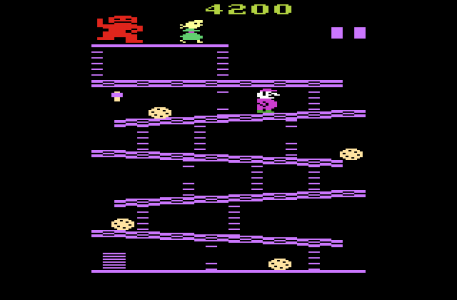
A black Background showing pink ( in this case ) platforms and ladders, seperating them from all other objects. beige cookies are the obstacles in game. A brown Ape like being can be found at the top which in fact is Donkey Kong. Pauline and Mario have a little more details showing more life like colours and physical appearance.


Atari 2600 Donkey Kong


Donkey Kong Series to Date


Donkey Kong Country 


Donkey Kong Country

Platform


SNES,
Game Boy Color,
Game Boy Advance,
Virtual Console

13 years later since the original Donkey Kong has come along way improving bot visually and game play wise. The technological advances allowed this to happen opening diverse ways of how the series can be carried out.


SNES Donkey Kong Country - Jungle Hijinks


Donkey Kong Country : Tropical Freeze


Tropical Freeze


Platform 


Wii U


Wii U - Donkey Kong Country: Tropical Freeze E3 Trailer


Gaming : The Black Onyx (Third Gen)


The Black Onyx


File:TheBlackOnyx SG1000 JP Box.jpg
Box cover

Game Details : 


Developer : Henk Rogers
Publisher : Bullet-Proof Software
Designer : Henk Rogers
Artist :  Rieko Kodama
Platform : Game Boy Color, MSX,Famicom, PC-6001,PC-8801, PC-9801,SG-1000

Release date :
PC-8801
JP 1984
MSX
JP 1985
Famicom
JP July 14, 1988

Genre :  Role-playing game
Mode :  Single-player

Game Information


This game was one of the most influential games to be released in Japan, created by Henk Rogers an American living in Japan. This game introduced a new kind of genre to the country, RPG  (Role Playing Game) and is considered to be an inspiration to many great grames such as Dragon Quest and Final Fantasy. The game could only utilize 15 fixed colours and only two can be mixed in the same 8x8 pixel tile due to the limitations of the SG-1000.

Plot 


A town called Utsuro is Engulbed in darkness and it is up to the player to form a party of heroes to tavel into dungeons to find the legendary Black Onyx. This will rid the darkness by breaking the curse and thus bringing light back into their light.

Gameplay


The players have the opportunity to create  a party that is limited to 5 members. The caves are found hidden in locations throughout the town. Once the player enters the cave he will have to face a 6 leveled dungeon which are colour coded. To progress thorough the game these dungeons must be won in a specific order. When the order is correct the player will find the black Onyx.

Only Melee combat can be found in the game because there is no dept/distance measured in the game. players can travel to the town to deposit money and upgrade items and heal themselves.

Expansions


Due to the limited amount of memory Expansions where created to further split the games and allow more features.

The Fire Crystal - Added a magic system to the game
The Moonstone - Added a wilderness exploration feature to the game
Arena - Added an Arena battle feature to the game.

Main Menu
This is where the player can choose several options to manage his warriors or continue to progress the game. Due to the limited colours there is too much blue which can be found in the background the floor the text and the walls. The text at least was visible.


Character creation
It gave you the ability to create custom warriors an let you select from a large ammount of hairstyles and a few cloathing options . These choices don't matter that much as they will be covered when armor is worn. With the black background it was easier to bring out all the items needed to be shown.

Dungeon/Town interface

To the top left you have the names of your warriors and the ammount of life each one has. Underneath you have two boxes on displaying your warriors and the other displaying who you are interacting with, being the npc's or the enemies 

Underneath that you will find a description of the action being chosen  in this case its the purchasing of a horned helm. In this box you will also find the battle logs when fighting an enemy. 
The bottom box holds the types of inputs you can enter to manage yourself at the specific location. The top right holds a visual representation of the town/dungeon you are moving through. 

[PC-88] The Black Onyx (1984) (BPS) [Translation]


Gaming : Sega SG-1000 (Third Gen)

Sega SG-1000


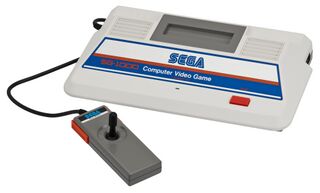
Sg1000.jpg


Technical Specifications


CPU: NEC 780C (clone of Zilog Z80)
3.579545MHz for NTSC, 3.546893MHz for PAL

Main RAM: 8 Kbits (1 KB)

VRAM: 128 Kbits (16 KB)

Sound: Texas Instruments SN76489
4 channel mono sound
3 sound generators, 4 octaves each, 1 white noise generator
Screen resolution: 256x192 (16 colors)

Ports:
1 Cartridge
1 RF output
1 joystick port (for player two, the first player's joystick is connected internally)
1 expansion port (compatible with the SK-1100 keyboard)


Graphical Changes : 

This console could display 32 sprites at any time on screen and also had a colour count of 16 and also having a resolution of 256×192 resolution. It had a little more resolution and also provided 8 more colours that the artist could work with from the previous generation.

History


The SG-1000 is a video game console utilizing cartridges for games. It was manufactured by Sega and was released 1983. It marked Sega's first steps into the video game console industry. The console initially did not provide that much success but its value lay in the experience gathered for future systems. 2 Million consoles where sold world wide. 


Nintendo Famicom


The console was held back from the beginning because it was going to be released on the same date as the Nintendo Famicon, so it had to be released on a later date. It had some support from Konami but the console was abandoned in 1985 with a few later releases the last being The black Onyx in 1987. 


The SG-1000 did have some competitors through its lifespan, Epoch,Tomy,Takara,Bandai,Casio and Nichibutsu. These where all systems which fell into oblivion with the major success of the Famicon. The SG-1000 though not the best successful console managed to fare better than the rest of these consoles but never manged to stay on top of the console market, this might be credited to the exclusive arcade games brought to the system. Another thing that set this console backward was its computer counter part, The SG-3000 which contained all the features and more making the console a little redundant. 


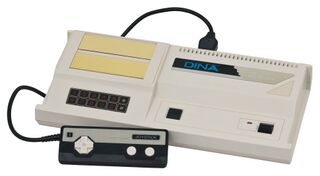
DINA2.jpg
Dina 2 in one 

The original console was also released in New Zealand where it was distributed under the name Grandstand. the console never reached North America or any other part of the world though the dina 2 in one SG-1000 compatible was released in the US by Telegames. With this being said the SG-1000 was the worst performing video game console in terms of units sold though the company still profited from it .


In July 1984 Sega had released another version of the console, marking it as the SG-1000 II which had hardware changes, the rear expansion port was moved to the front and changed the controllers to to have a similar appearance to that of the Famicon. This version was only known to be released outside of Japan in Taiwan where it was distributed by Aaronix


OthelloMultivision FG-1000 1.jpg
Othello Multivision


There where several clones of the SG-1000, one being the Othello multivision form the licensed game manifacture Tsukuda Original. The plan was to focus more on creating a computer game standard which allowed companies to focus more on games rather than hardware. Another was The Dina 2 in one which was produced bu Bit Corp which was likly to be produced without a licence. This console had the ability to run Coleco Vision games and was distributed in North America by Telegames under the name Telegames Personal Arcade. The SG-1000 was also released in "module" form as the Pioneer TV Video Game Pack SD-G5.


All forms of these consoles failed to win the marked Sega was aiming for, this lead to the creation of the Sega Mark III, They improved on the video hardware and increased the RAM. This system would later be the starting point of the Sega Master System. These two consoles are backward compatible with the SG-1000.

Commercials 


References 

Wikipedia. 2015. SG-1000. [ONLINE] Available at: http://en.wikipedia.org/wiki/SG-1000. [Accessed 23 April 15].

SegaRetro. 2015. SG-1000. [ONLINE] Available at: http://segaretro.org/SG-1000. [Accessed 23 April 15].

Video Console Game Library. 2015. SG-1000. [ONLINE] Available at:http://www.videogameconsolelibrary.com/pg80-sg1000.htm#page=reviews. [Accessed 23 April 15].